



Commercial buildings face increasing pressure to maximize usable square footage while meeting strict sustainability mandates. Traditional rooftop HVAC systems often consume valuable roof area, complicate structural loads, and drive up installation costs. Adopting compact VRF outdoor units resolves these spatial constraints without sacrificing performance or tenant comfort.
Create Space on Your Roof: Optimizing Commercial Spaces with Compact VRF Outdoor Units.
Quick Answer: Compact VRF outdoor units reduce rooftop equipment footprint by up to 60 percent while delivering precise, zone-by-zone climate control. They achieve this through advanced inverter-driven compressors, modular refrigerant piping, and integrated heat recovery systems that operate efficiently across varying load conditions. Building managers should prioritize structural load analysis, acoustic zoning, and phased retrofitting when transitioning from conventional rooftop packages to compact VRF configurations.
Why Traditional Rooftop HVAC Fails Modern Commercial Demands
Ayrıca TİCARİ MEKANİK SİSTEMLERİN YAŞAM DÖNGÜSÜ MALİYET ANALİZİ. içeriğinde bu konunun ilgili kısmını detaylıca bulabilirsiniz.
Legacy rooftop units (RTUs) rely on fixed-speed scroll or screw compressors that cycle frequently under partial loads, wasting energy and accelerating mechanical wear. These systems occupy large footprints because they house all mechanical components within a single chassis, leaving little room for solar arrays, green roofing, or tenant terraces. Furthermore, RTUs generate high static pressure losses due to bulky ductwork requirements and struggle with precise zone temperature differentiation. As commercial real estate shifts toward asset optimization and net-zero targets, the inability of traditional units to adapt to dynamic occupancy patterns becomes a critical operational bottleneck.
How Compact VRF Systems Redefine Roof Load and Layout
Ayrıca Güneş ışığı alan evlerde, klima kullanımının nasıl optimize içeriğinde bu konunun ilgili kısmını detaylıca bulabilirsiniz.
Variable Refrigerant Flow technology decouples cooling and heating functions by circulating refrigerant directly to indoor terminals based on real-time demand. This architectural shift allows manufacturers to stack components vertically, utilize smaller inverter compressors, and route thinner copper linesets instead of heavy ductwork. The result is a dramatic reduction in both ground footprint and dead load weight.
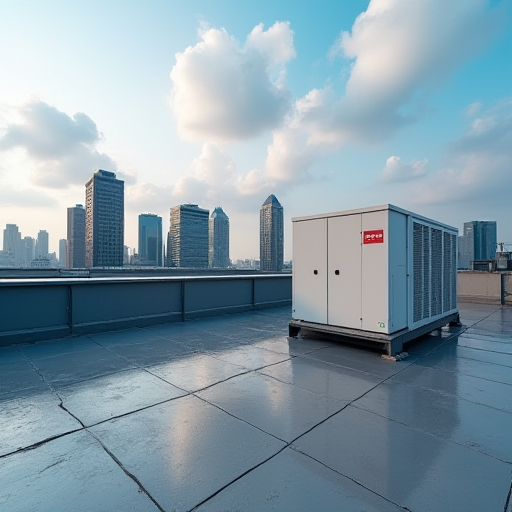
Compact VRF outdoor units also incorporate modular designs that enable scalable capacity expansion. Instead of replacing entire rooftop packages during capacity upgrades, facility teams can add parallel modules or extend linesets to new wings. This modularity minimizes structural stress on existing roof decks and simplifies logistics during installation.
Sizing and Placement Strategies for Maximum Efficiency
Ayrıca VRF sistemi nedir? Nerede kullanılır? | VRF Nedir? içeriğinde bu konunun ilgili kısmını detaylıca bulabilirsiniz.
Proper sizing begins with detailed load calculations that account for solar gain, internal equipment heat, ventilation requirements, and concurrent heating/cooling demands. CFD modeling and Manual J/S methodologies help identify peak loads without oversizing equipment. Once capacity is determined, placement must follow strict clearance guidelines: typically 600 mm on all sides for service access and 1500 mm at the air intake to prevent recirculation.
Decision criteria for layout include wind exposure profiles, noise propagation boundaries, and elevation differences between outdoor modules and indoor heads. High-rise installations require careful consideration of refrigerant charge limits and vertical lift compensation. Concrete examples show that positioning units near core stairwells or service shafts reduces piping runs by 40 percent while isolating operational noise from occupied zones.
Integration Challenges and Structural Considerations
Ayrıca Mesafeli Satış Sözleşmesi içeriğinde bu konunun ilgili kısmını detaylıca bulabilirsiniz.
Transitioning to compact VRF systems introduces specific engineering constraints that must be addressed during the design phase. Existing roof membranes require reinforced curbs and waterproofing flashings to prevent leaks at penetration points. Electrical infrastructure often needs panel upgrades to accommodate high-voltage three-phase power and advanced inverter control wiring.
Building management system (BMS) integration relies on BACnet or Modbus communication protocols, requiring dedicated gateways and network segregation. In seismic zones or coastal environments with salt spray exposure, certified mounting brackets and corrosion-resistant coatings become mandatory. Edge cases include retrofits in historic buildings where roof load limits are strictly capped; in these scenarios, lightweight aluminum condensers and split-module configurations provide viable alternatives without compromising structural integrity.

Maintenance Protocols That Extend Equipment Lifespan
Ayrıca Portfolyo içeriğinde bu konunun ilgili kısmını detaylıca bulabilirsiniz.
Compact VRF outdoor units demand disciplined maintenance schedules to preserve efficiency and prevent premature failure. Quarterly tasks include cleaning condenser fins, verifying refrigerant charge levels using superheat/subcooling calculations, and inspecting fan motor bearings for vibration anomalies. Annual protocols should encompass electrical terminal tightening, control board firmware updates, and comprehensive airflow testing.
While compact designs improve technician access compared to traditional RTUs, they also require stricter adherence to manufacturer service intervals due to tighter component tolerances. Implementing predictive maintenance through IoT-enabled sensors that monitor compressor amperage, discharge temperatures, and refrigerant pressure trends allows facility teams to address micro-failures before they escalate into costly downtime events.
ROI Calculation and Long-Term Energy Savings
Financial justification for compact VRF installations hinges on comparing upfront capital expenditures against operational savings over a 15-year lifecycle. Key metrics include seasonal energy efficiency ratio (SEER), heating seasonal performance factor (HSPF), and part-load efficiency curves that outperform conventional systems by 30 to 50 percent. Utility rebate programs and demand response incentives frequently offset initial costs, shortening payback periods to three or four years.
Real-world commercial deployments demonstrate measurable outcomes: a mid-rise office complex reduced its rooftop equipment footprint by 45 percent while cutting annual energy consumption by 38 percent. Additional value emerges from extended equipment lifespan, reduced maintenance contracts, and improved tenant retention driven by consistent thermal comfort and quieter mechanical operations.

Frequently Asked Questions
Can compact VRF units handle extreme climate conditions?
Yes, modern compact VRF outdoor units are engineered with low-ambient cooling kits and high-ambient heating capabilities, typically operating reliably between -20°C and 52°C. Advanced defrost cycles and variable fan speeds maintain capacity during temperature extremes.
What is the maximum vertical height difference allowed for refrigerant lines?
Standard installations permit up to 90 meters of vertical lift, though specific models may extend to 150 meters with additional oil return traps and compressor upgrades. Always consult manufacturer specifications for long-reach configurations.
How does a compact VRF system compare to chilled water plants in large facilities?
VRF systems excel in medium-scale buildings requiring precise zoning and rapid load response, while chilled water plants remain superior for massive campuses or processes demanding consistent humidity control and centralized plant management.
Are there specific building codes that restrict rooftop VFR installation?
Local mechanical codes govern refrigerant charge limits, fire separation distances, noise ordinances, and seismic bracing requirements. Compliance typically involves submitting engineered drawings to the Authority Having Jurisdiction (AHJ) prior to permit issuance.
Final Summary
- Compact VRF outdoor units significantly reduce rooftop footprint while delivering precise, zone-level climate control.
- Inverter-driven compressors and modular refrigerant piping enable scalable capacity without excessive structural loading.
- Accurate load calculations and strategic placement prevent recirculation, noise complaints, and efficiency losses.
- Structural reinforcements, BMS integration, and corrosion-resistant mounting address critical retrofit constraints.
- Predictive maintenance protocols and IoT monitoring extend equipment lifespan and minimize unplanned downtime.
- Financial models consistently show rapid payback periods driven by energy savings, utility incentives, and operational reliability.
Quick Answer
Core approach for Create Space on Your Roof: Optimizing Commercial Spaces with Compact VRF Outdoor Units.: planning clearly, measuring consistently, and optimizing iteratively.
Conclusion
In short, a clear strategy helps achieve sustainable and measurable outcomes.
Additionally, this approach supports consistency over time. On the other hand, regular analysis accelerates improvement.